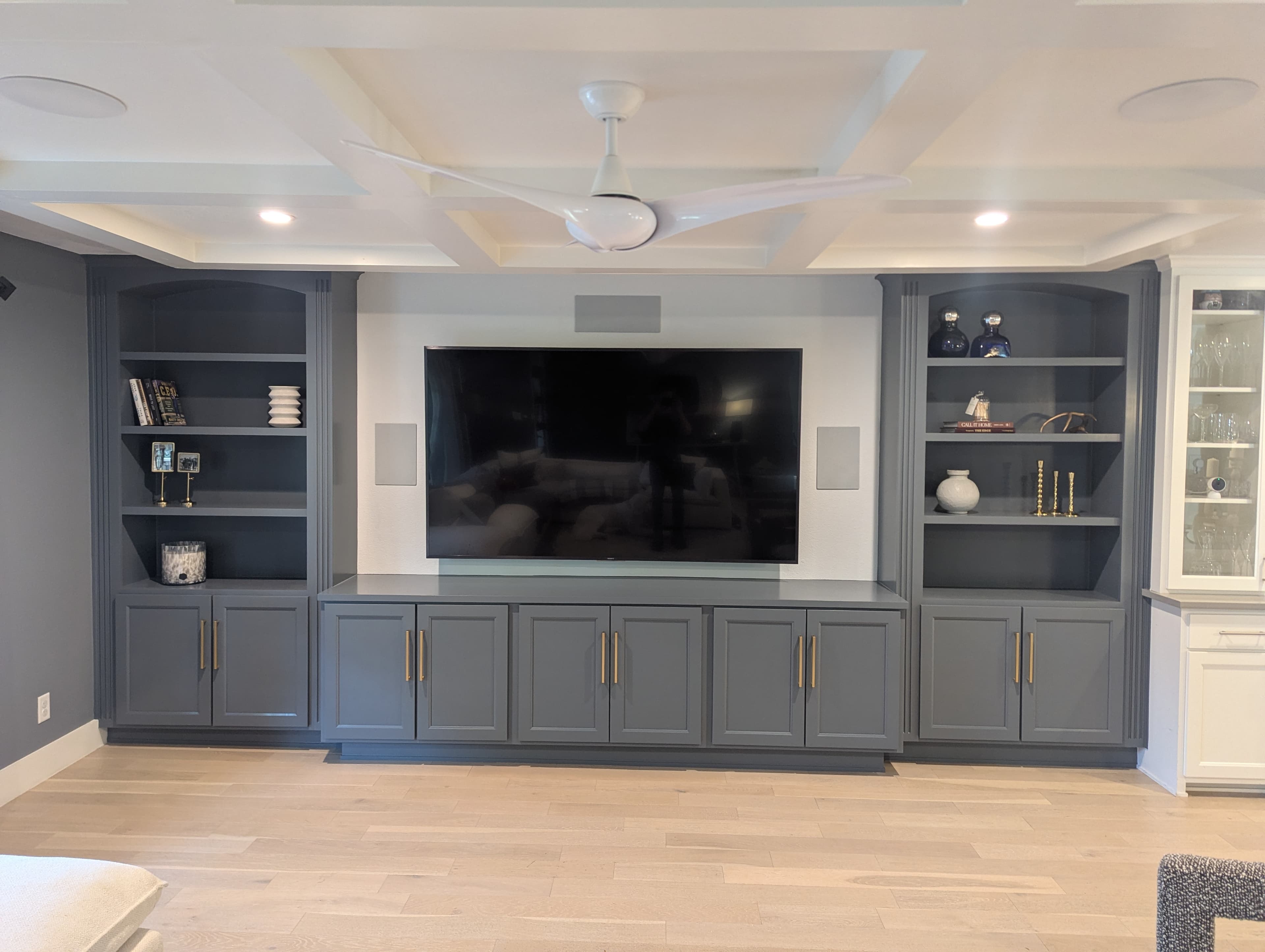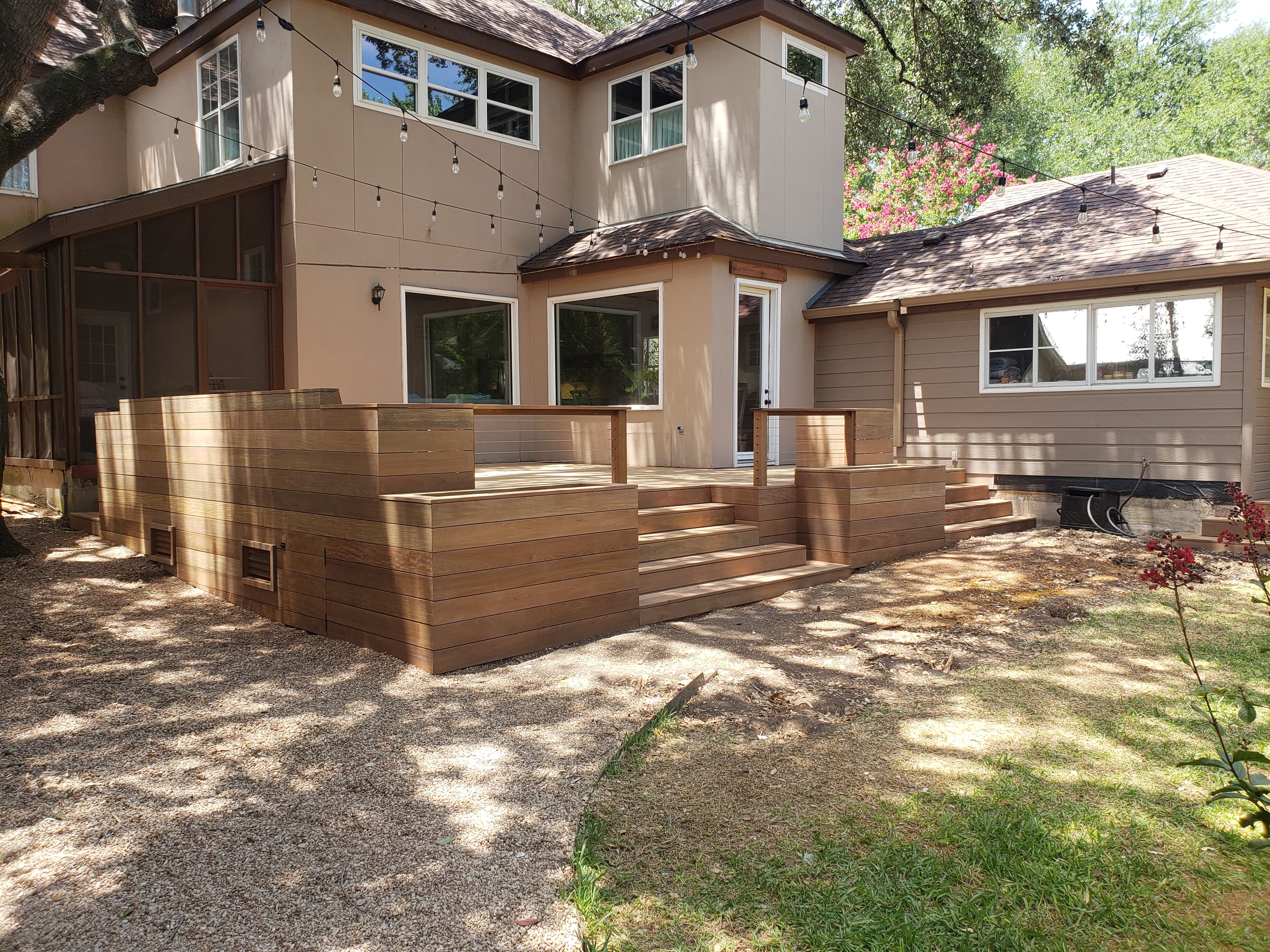
Finished custom cabinetry with us starts at $385 per linear foot. Below, we cover what makes a cabinet custom, how it compares with stock, semi-custom and refacing (see the table), what moves the price, and what some of our own projects cost.
"Custom" gets used loosely. Some people mean a factory cabinet in a paint color they picked. Some mean anything that didn't come off a shelf at a big box store. If you're getting bids for a kitchen or a built-in, it helps to know what the word should mean, because that's what you're paying for.
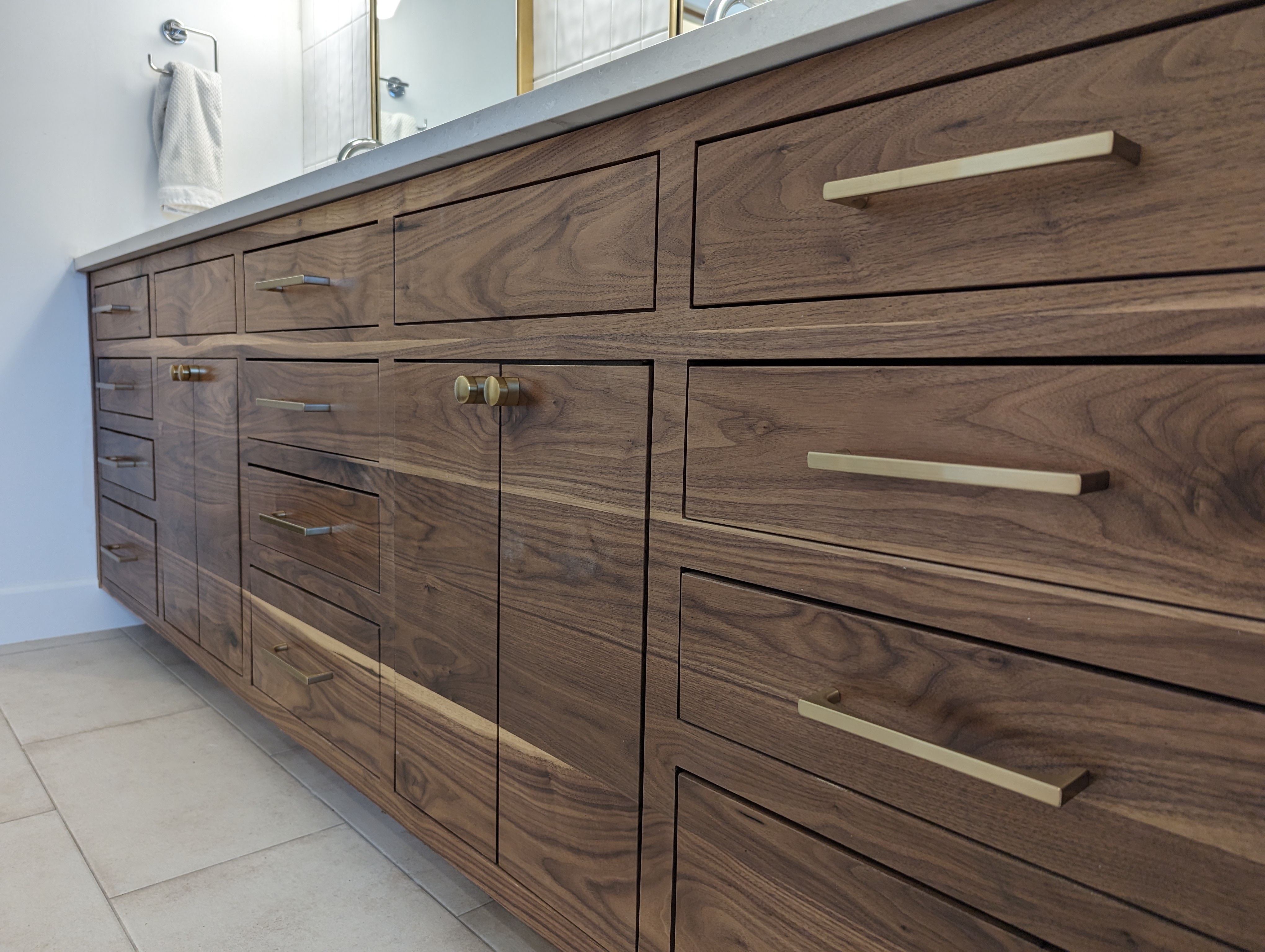
What makes a cabinet custom
We hold it to three things: no filler strips, every box built to the room's actual size, and styles or layouts a factory line doesn't offer. If a cabinet meets all three, it's custom. If it doesn't, it isn't.
No filler strips
Factory cabinets come in set widths. When a wall doesn't divide evenly into those widths, the leftover space at the end gets covered with a filler. With custom work there isn't one, because the boxes are sized to the wall.
Every box built to size
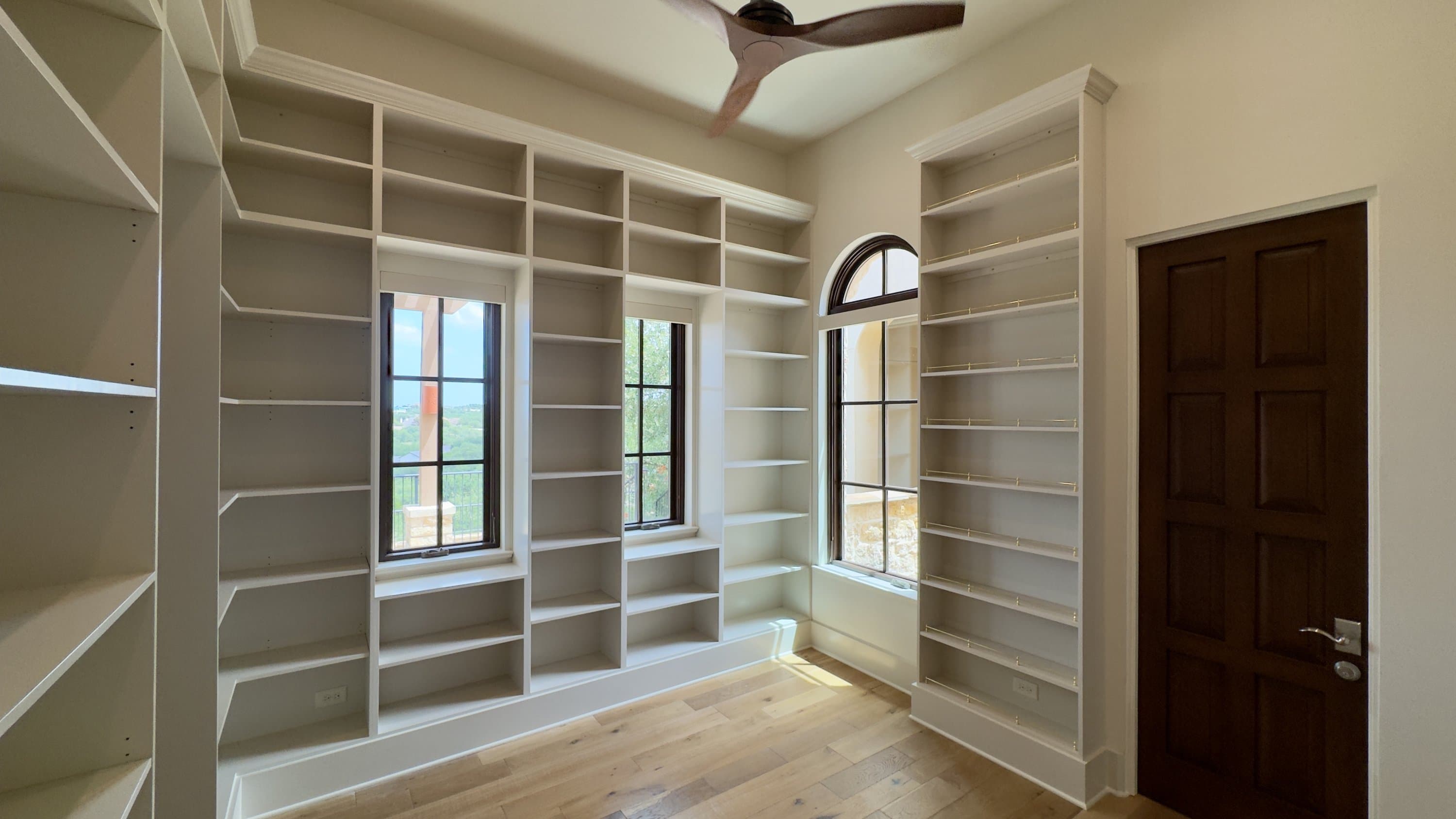
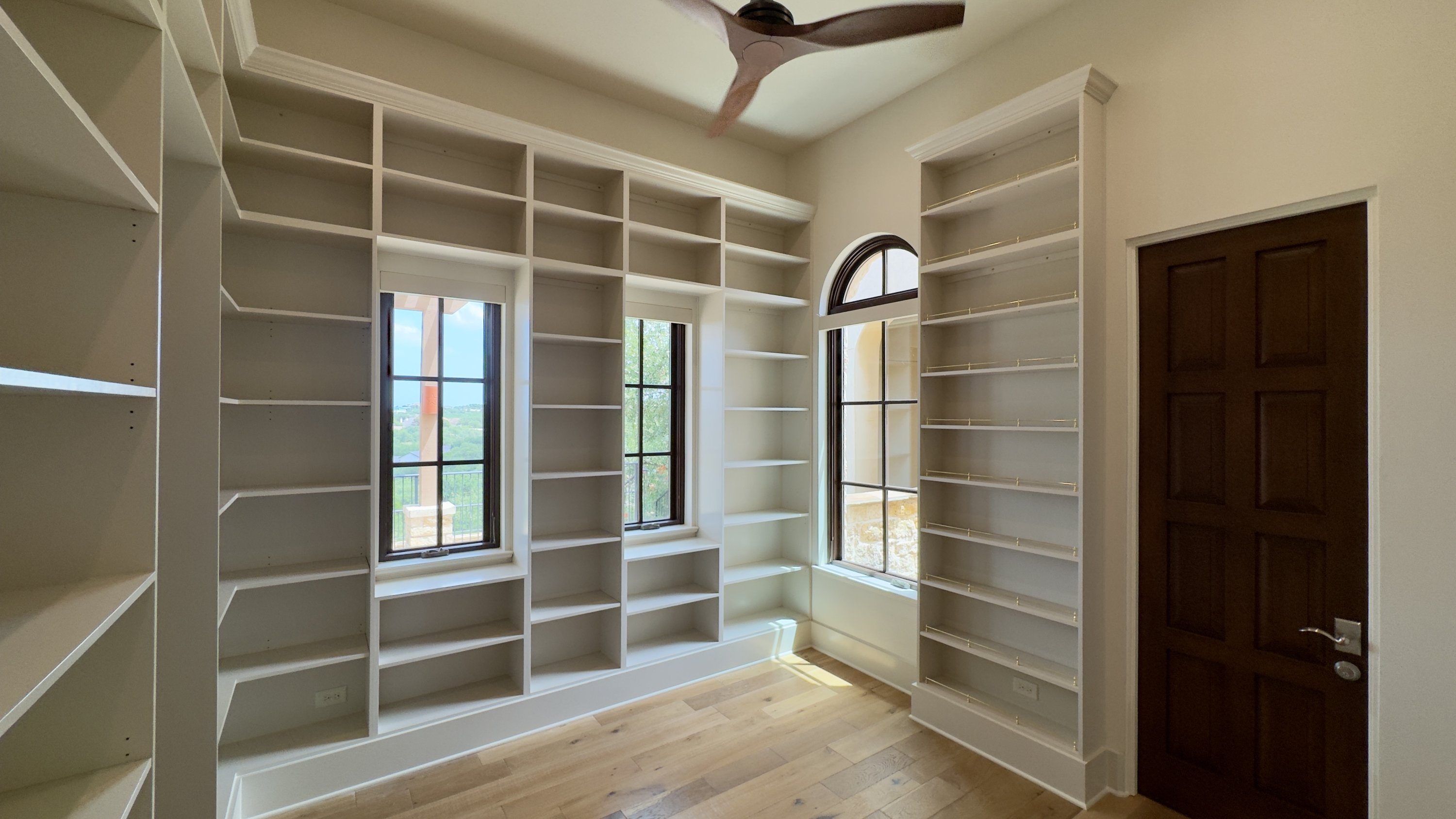
Each box is made to the dimension the room needs, not rounded to the nearest size in a catalog. On the built-in library we did in Boerne, every section was sized to its own wall.
Styles and layouts a factory doesn't offer
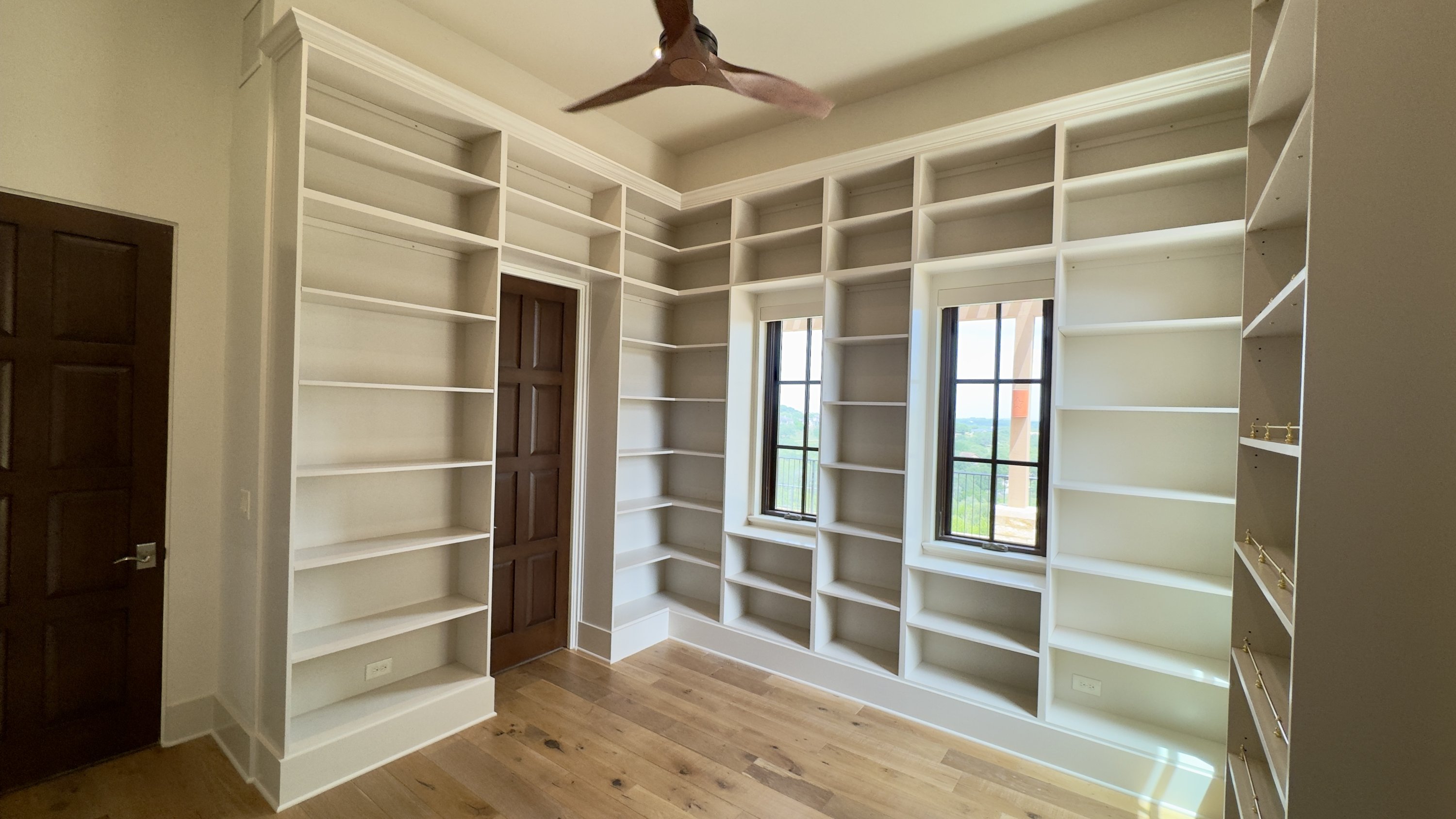
Custom can mean a height, depth, door style or layout a catalog doesn't list, like shelving that wraps a window. The same Boerne library runs around two windows, an arched window and a doorway, on walls about 10 ft tall. A catalog won't offer that.
Stock, semi-custom, custom and refacing compared
| Option | What it is | Price with us |
|---|---|---|
| Stock | Factory cabinets in set widths. Where a wall doesn't divide evenly, a filler strip covers the gap. | Depends on the line you pick. We install it. |
| Semi-custom | A catalog line that lets you change some sizes and finishes. The boxes still start from the catalog. | Depends on the line you pick. We install it. |
| Custom | Every box built to the room's actual size in our shop, with no filler strips and the style or layout the room needs. | From $385 per linear foot, finished |
| Refacing | Keeps your existing boxes and changes what you see, like the doors and the finish. The layout and sizes stay the same. | Priced with the rest of the room. See refacing below. |
Custom is the only one we price by the foot. Stock and semi-custom depend on the line you choose, and refacing is priced as part of a kitchen refresh (below).
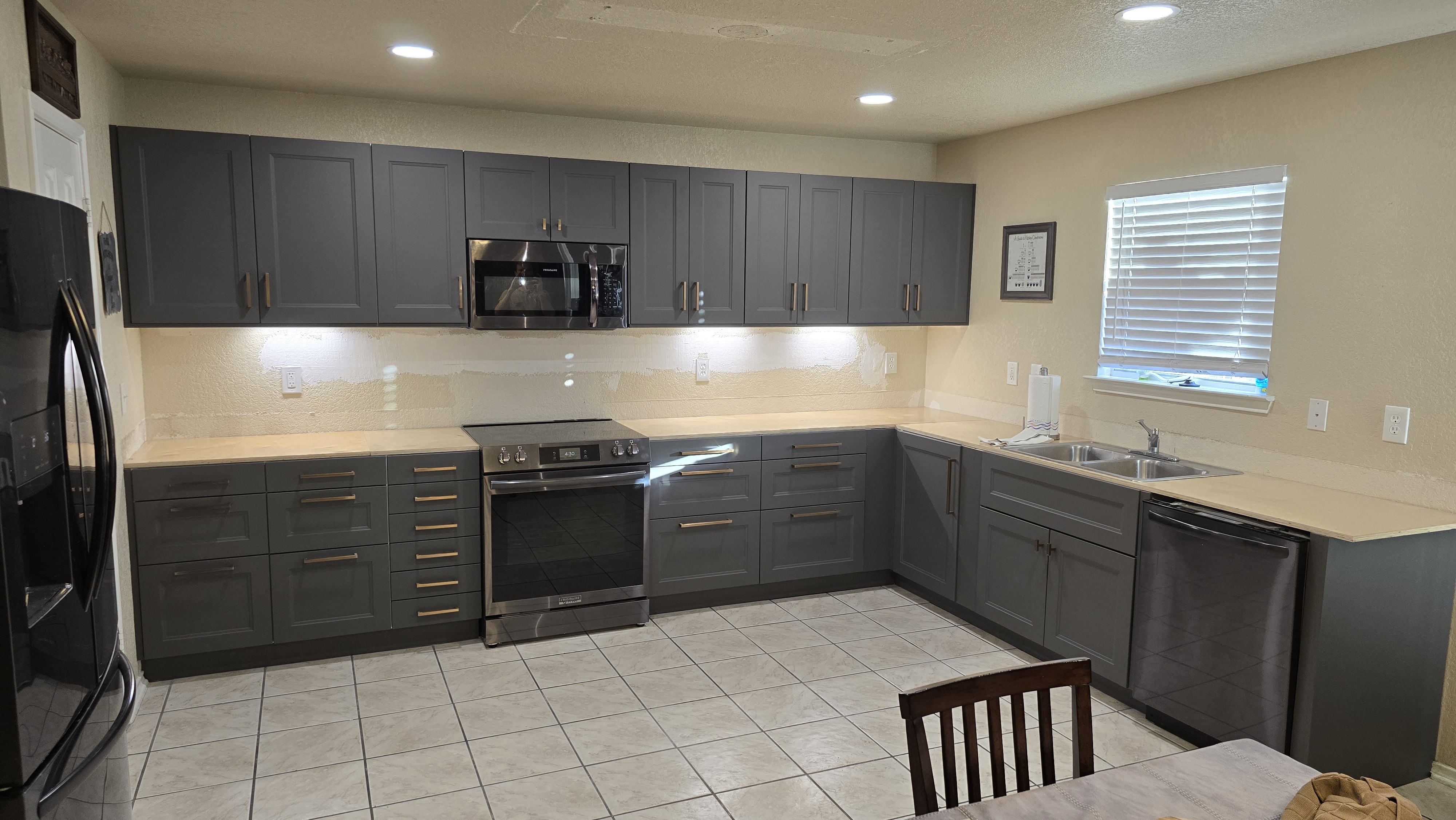
By our definition, neither stock nor semi-custom is custom. Flat-pack (RTA) cabinets, IKEA included, are the same: you can pick fronts and mix sizes, but the boxes still come in fixed increments and the layout has to work around them.
None of that makes them a bad choice. We install stock and manufactured cabinets, including Lowe's lines, and we install IKEA kitchens. For the right room and budget, any of them can be the right call.
Refacing vs new cabinets
Refacing or refinishing keeps your existing cabinet boxes and changes what you see. If your boxes are sound and the layout already works, it can make sense. It doesn't change the layout or the sizes, so it doesn't make the cabinets custom.
On a kitchen, a refresh or cabinet reface with us usually runs $5,000-$20,000. That keeps the layout and changes the surfaces: refacing or painting the cabinets, new countertops and backsplash, updated hardware and fixtures, paint and lighting.
So there are three paths. Fully custom, built in our shop, makes sense when the room needs something a catalog can't do: odd walls, a specific species, an exact height. A manufactured line we install is often the right call when the layout is standard or the timeline is tight. And if your boxes are sound and it's really the doors and the finish you're unhappy with, refacing gets you a new look without paying for a full replacement.
We handle refacing and stock installs as part of our kitchen remodeling work.
What custom cabinets cost
Finished custom cabinetry starts at $385 per linear foot. Lowers and uppers are each counted by the foot, so a wall with both counts its length twice. If you want the cabinets delivered unfinished so you can finish them yourself, it comes in lower.
Most bathroom vanities we build run $2,000-$5,000, and built-ins run $4,000-$20,000.
That's a starting point, not a quote. These are what move the number:
- Length of the run
- Height
- Paint vs stain
- Door style
- Face frame vs frameless
- Wood species
- How much has to be fitted around walls that aren't flat or square
The last one gets underestimated. Walls are rarely flat or square, and every bit of fitting is shop and install time.
Some real projects, so you can see the scale. We give ranges where we have them, not exact totals, since every room is priced on its own.
- Built-in library, Boerne, 2026: about 22 ft of cabinetry, uppers and lowers, frameless birch plywood, brass gallery rails, painted Sherwin-Williams Accessible Beige inside and out. $20,000-$25,000.
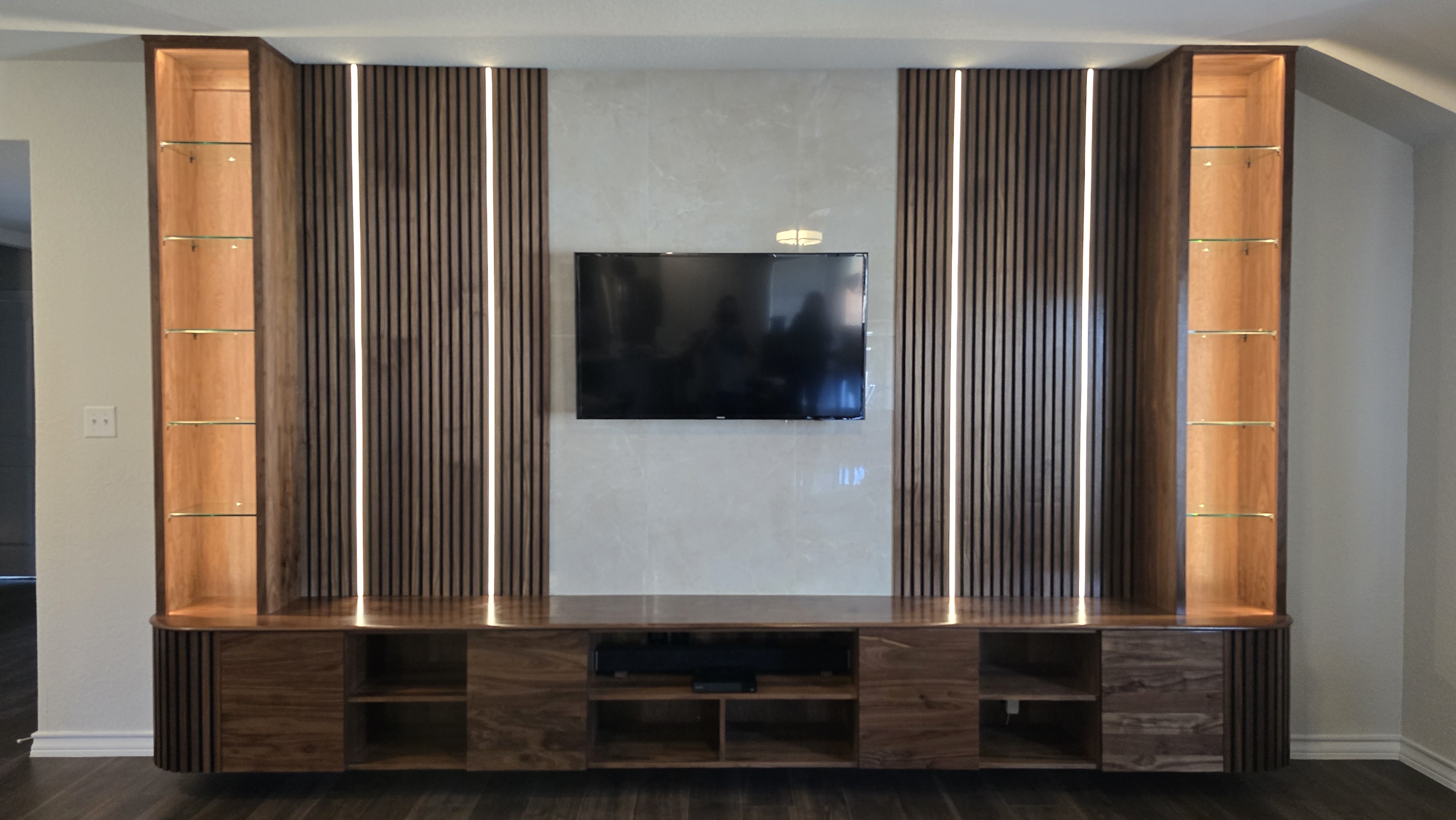
- Floating walnut media wall, San Antonio, 2025: walnut cabinetry hung on a French cleat, reeded panels and lit glass-shelf towers. We also set the tile, mounted the TV and did the low-voltage lighting. A wall like it runs in the mid $20,000s.
- One painted Shaker-style upper cabinet, 67 1/4 in. wide: $2,000-$2,500.
Custom vs stock: one real comparison
On one recent kitchen, Lowe's stock cabinets came to about $371 per linear foot installed. Most of that was a $285 per linear foot cabinet allowance and $80 per linear foot to install. That's one job, not a rule. But it shows custom can land closer to stock than people expect.
Is custom worth it?
The main reason we'd steer someone away from custom is budget. If the budget is tight, a stock line or an IKEA kitchen installed well is a sensible choice, and we'll say so.
If the room has odd dimensions, tall walls, windows to work around, or you want a layout no factory sells, that's where custom earns its price. Built-ins are a good example, since they have to fit one specific wall. See our built-in shelving page for more of that work.
How we build them
We do the design, the cabinets and the carpentry in-house.
- We design the cabinets in Mozaik, cabinet design software.
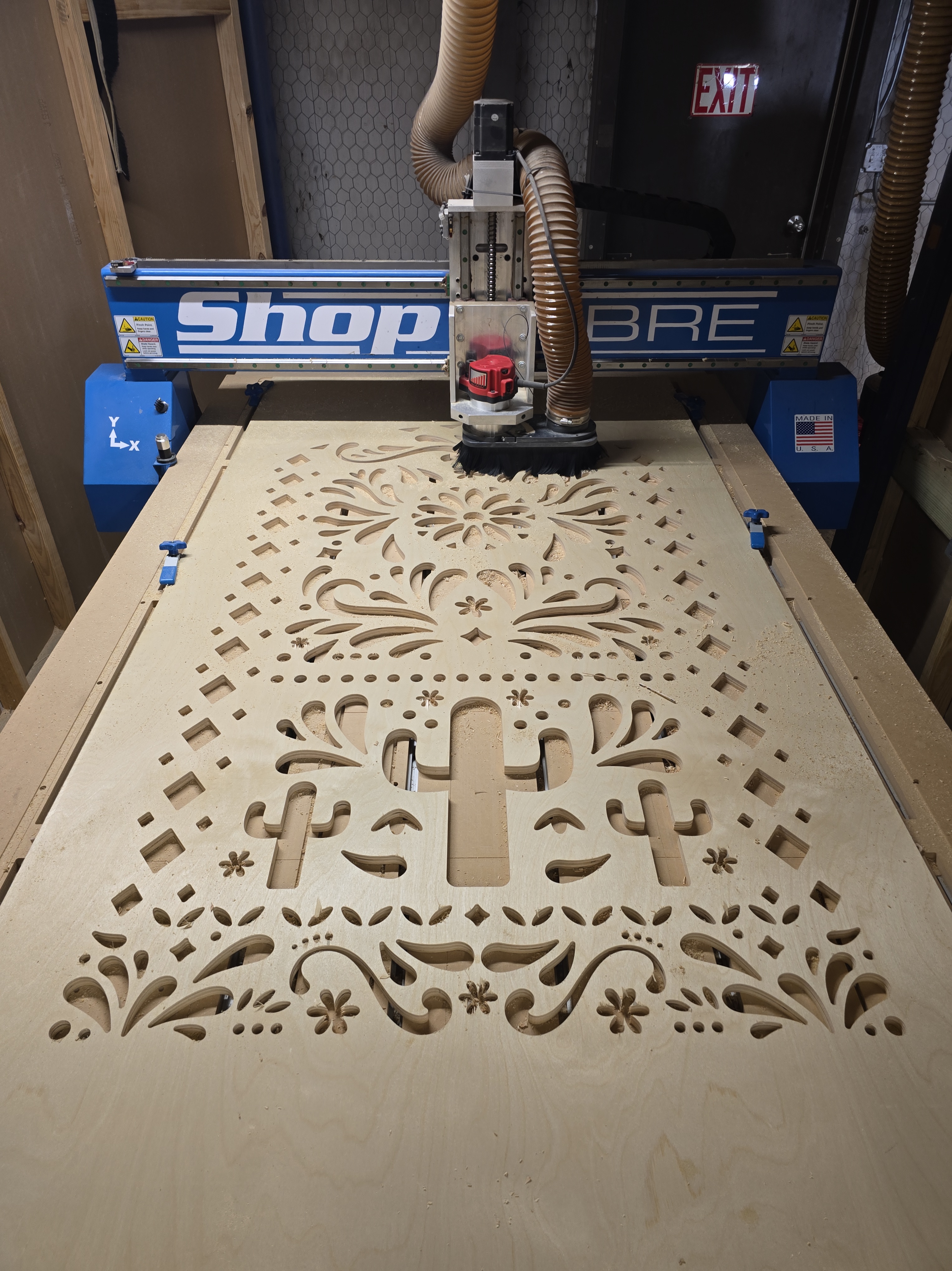
- Parts are cut on our own CNC router in our shop.
- Our standard box is plywood with a UV-prefinished interior, edge-banded.
- We build the doors for most of our cabinet work in our own shop. On some jobs we order doors and drawer fronts from a dedicated door shop when that saves the client time or money.
- Finishing depends on the job. It might happen in our shop, with a finishing partner, or on site.
Our default is face-frame cabinets, with a standard door overlay of 1/2 in. We also build frameless when the design calls for it: no face frame, usually with full-overlay doors. Neither style is better across the board. It comes down to the look you want and what suits the room.
Typical lead time is 4 to 8 weeks, depending on how much work is in the shop at the time. We'll give you a timeline for your job once the scope is set.
Two questions to ask any cabinet builder
Ask where the boxes are built, and whether the layout uses filler strips. A company that can run a whole remodel doesn't always build its own cabinets. That's fine, as long as you know which kind of boxes you're getting.
Our custom cabinet FAQ covers more questions, and our custom cabinetry page shows more of our work. When you want to talk about your room, you can reach us here.